
Reconstitution 101: from lyophilized vial to syringe unit
Peptides ship as freeze-dried (lyophilized) powder because the water of solution is what peptides degrade in fastest. Before you can inject anything, you have to add a sterile diluent — almost always bacteriostatic water — and then compute three numbers: the concentration of the resulting solution, the volume that contains your prescribed dose, and the syringe unit count that volume corresponds to. This guide walks through each step in plain language with worked examples.
Step 1 — Inspect the vial
The vial label tells you the total mass of peptide inside, almost always in milligrams. Common sizes are 2, 5, 10, 15, and 30 mg. The label also tells you the storage conditions — most lyophilized peptides are stable at room temperature for transport but should be refrigerated for long-term storage even before reconstitution.
Step 2 — Choose your BAC water volume
Bacteriostatic water (BAC water) is sterile water with 0.9% benzyl alcohol added as a preservative. The benzyl alcohol prevents bacterial growth in a multi-dose vial — which matters because you'll be drawing from the same vial repeatedly over days or weeks. For how it differs from plain sterile water and saline, see bacteriostatic water vs. sterile water vs. saline.
The volume of BAC water you add does not change the total amount of peptide in the vial — it only changes the concentration of the resulting solution. More water = lower concentration = larger draw volume. Less water = higher concentration = smaller draw volume. The most commonly used volumes are 1 mL, 2 mL, and 3 mL because they map cleanly to U-100 insulin-syringe units.
A practical rule: pick the BAC water volume so your typical single dose lands somewhere between 10 and 50 units on a U-100 syringe. Below 10 units the volume is awkwardly small and prone to measurement error. Above 50 units the dose is taking up half the syringe.
Step 3 — Reconstitute carefully
Inject the BAC water slowly along the inner wall of the vial — do not squirt it directly onto the lyophilized cake. Once the water is in, swirl gently for ten or twenty seconds. Do not shake. Shaking creates microscopic foam that can denature peptide molecules at the air-water interface. The cake should dissolve fully within a minute or two; if you see particles after several minutes of swirling, something is wrong with the vial — set it aside.
Step 4 — Compute the concentration
The concentration in milligrams per millilitre is just division:
concentration (mg/mL) = vial mass (mg) ÷ BAC water (mL)
Example: a 10 mg tirzepatide vial reconstituted with 2 mL of BAC water gives you a 5 mg/mL solution.
Step 5 — Compute the volume per dose
The volume of solution that contains your prescribed dose is also just division:
volume per dose (mL) = dose (mg) ÷ concentration (mg/mL)
Continuing the example: if your dose is 2.5 mg and the concentration is 5 mg/mL, the volume per dose is 0.5 mL.
Step 6 — Convert volume to syringe units
Insulin syringes are calibrated for U-100 insulin: 100 units = 1 mL. A few syringes are U-40 (40 units = 1 mL), used in some veterinary contexts. For U-100:
U-100 units = volume (mL) × 100
A 0.5 mL volume is therefore 50 units on a U-100 insulin syringe. That's the number you read off the barrel as you draw.
Putting it together
- 10 mg tirzepatide vial
- 2 mL bacteriostatic water added
- = 5 mg/mL concentration
- 2.5 mg prescribed dose
- = 0.5 mL volume to draw
- = 50 units on a U-100 insulin syringe
- = 4 doses per vial
Or skip the math entirely and use the calculator — it runs the same arithmetic instantly, supports U-40 syringes, computes doses-per-vial, and lets you save the calculation by sharing the URL.
Common mistakes
- Shaking the vial. Foam denatures peptide. Always swirl, never shake.
- Reconstituting with sterile water for single-use vials. Sterile water without preservative has no antimicrobial protection. Single-use is fine; multi-day multi-dose use is not.
- Forgetting to recalculate after changing BAC water volume. Adding 2 mL instead of 1 mL halves your concentration, doubling your draw volume for the same dose.
- Confusing mg and mcg. 0.25 mg = 250 mcg. Many peptide labels mix the two.
- Drawing from a U-40 syringe assuming U-100 calibration. Always check the syringe scale.
Storage after reconstitution
Reconstituted peptide should be refrigerated at 2–8 °C and protected from light. Stability windows vary by peptide and by compounder — the label or pharmacy beyond-use date is authoritative. For most peptides, expect 14–60 days of refrigerated stability. Avoid freezing reconstituted solution unless the manufacturer specifies it's safe.
Reconstitution supplies
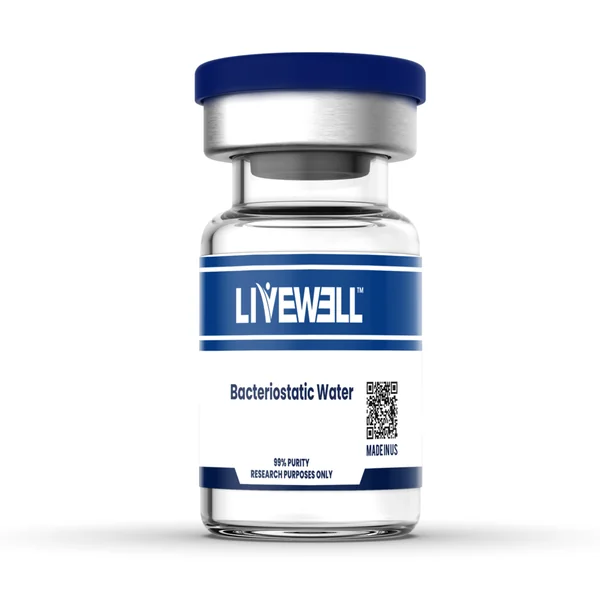
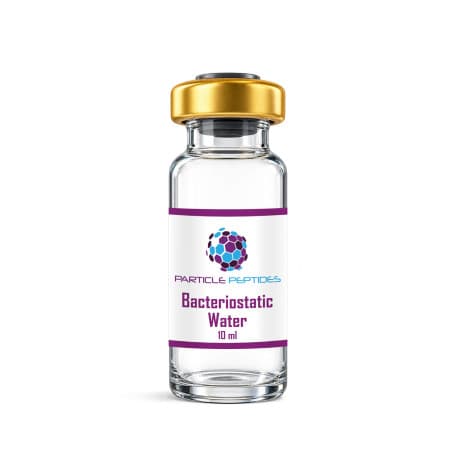
Bacteriostatic water from vendors manually vetted for third-party COA practice. LiveWell ships within the US; Particle ships to the EU, UK and Switzerland.

USA-based research vendor publishing a per-lot Certificate of Analysis and dispatching same-day via USPS, UPS Ground or FedEx, with 3–5 day standard delivery. Ships within the United States only. Also stocks reconstitution supplies and several compounds in oral tablet form, including orforglipron, tesofensine and dihexa.
Buy Bacteriostatic Water (3mL / 10mL) →Affiliate link — we may earn a commission at no extra cost to you.
 Particle Peptides
EU-based vendor (Slovakia, since 2015) shipping to EU, UK, and Switzerland. The only European supplier publishing all seven test parameters per batch (purity, identity, content, bioburden, endotoxins, heavy metals class 1 & 2). Manufacturer is cGMP / ISO 9001 / ISO 13485 compliant.
Buy Bacteriostatic Water 10mL →Affiliate link — we may earn a commission at no extra cost to you.
PeptideDose is an educational reference. It is not medical advice and does not replace consultation with a licensed healthcare provider. Doses shown in presets are derived from published protocols and product labels — they are not personal recommendations.