
Tesamorelin mcg to units conversion
Convert a microgram dose into insulin-syringe units, computed for the 5 mg vial reconstituted with 2 mL of bacteriostatic water — the standard reference presentation on the Tesamorelin page.
On the reference 5 mg / 2 mL vial (2.5 mg/mL), 1 mg of Tesamorelin = 40 units on a U-100 syringe, and 1 unit = 0.025 mg. Full lookup table below.
Tesamorelin mcg to units at 2.5 mg/mL
Vial: 5 mg · BAC water: 2 mL · Syringe: U-100
| Input | Equivalent |
|---|---|
| 50 mcg | 2 units |
| 100 mcg | 4 units |
| 200 mcg | 8 units |
| 250 mcg | 10 units |
| 300 mcg | 12 units |
| 500 mcg | 20 units |
| 750 mcg | 30 units |
| 1000 mcg | 40 units |
| 1500 mcg | 60 units |
| 2000 mcg | 80 units |
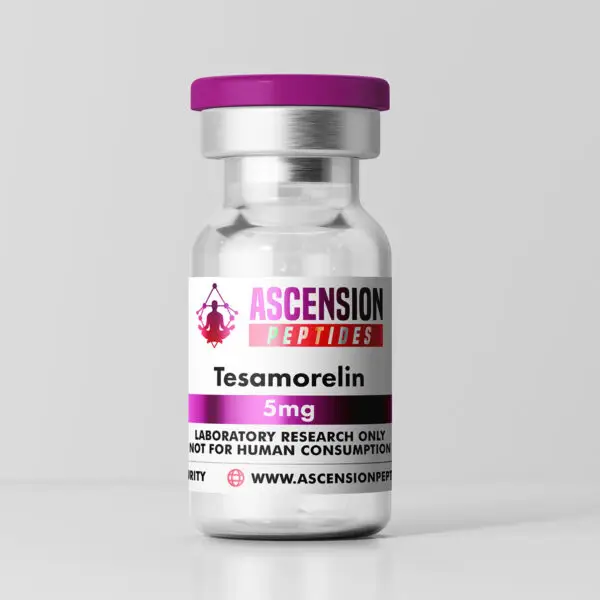
Where researchers source this
Vendors below have been manually vetted for third-party COA practice and shipping reliability. Verify the current Certificate of Analysis on the vendor's product page before purchase.

The arithmetic, step by step
Every reconstitution conversion comes back to one number: the concentration of peptide per millilitre of solution. With 5 mg of Tesamorelin dissolved in 2 mL of bacteriostatic water, the concentration is 5 ÷ 2 = 2.5 mg/mL. Once that figure is fixed, every other conversion follows from it.
A U-100 insulin syringe is graduated to 100 units per millilitre. That means one unit on the barrel corresponds to 1 ÷ 100 = 0.01 mL of solution, which carries 0.025 mg of Tesamorelin. Multiplying through by the number of units drawn gives the dose in milligrams; dividing a target dose by that per-unit mass gives the units to draw. The lookup table above is just those two operations applied at common round-number inputs.
The micro-to-milli conversion sits one step above this layer. One milligram is 1,000 micrograms, so a 1 mg reference dose is the same as 1000 mcg of Tesamorelin. The mass does not change with the unit label — the calculator and the lookup table treat the two interchangeably.
These figures hold only at the listed vial-to-water ratio. Tesamorelin is also shipped in vial sizes of 1 mg, 2 mg, 5 mg, 10 mg in research-vendor presentations, and changing the vial size — or the volume of BAC water used to reconstitute it — produces a different concentration and therefore a different lookup table. The calculator handles those overrides directly.
Concentration at other common vial sizes
Tesamorelin ships in several vial sizes. At a fixed 2 mL of BAC water, the concentration scales linearly with the vial — and so does every value in the lookup table.
| Vial size | Concentration | 1 mg draws |
|---|---|---|
| 1 mg | 0.5 mg/mL | 200 units (2 mL) |
| 2 mg | 1 mg/mL | 100 units (1 mL) |
| 5 mg | 2.5 mg/mL | 40 units (0.4 mL) |
| 10 mg | 5 mg/mL | 20 units (0.2 mL) |
Other Tesamorelin conversion references
Frequently asked questions
- How many units is 1 mg of Tesamorelin?
- 40 units on a U-100 insulin syringe, at the reference 5 mg / 2 mL concentration (2.5 mg/mL). At a different vial-to-water ratio the unit count changes — use the calculator to adjust.
- How many units is 1.4 mg of Tesamorelin?
- 56 units on a U-100 insulin syringe, at the reference 5 mg / 2 mL concentration (2.5 mg/mL). At a different vial-to-water ratio the unit count changes — use the calculator to adjust.
- How many units is 2 mg of Tesamorelin?
- 80 units on a U-100 insulin syringe, at the reference 5 mg / 2 mL concentration (2.5 mg/mL). At a different vial-to-water ratio the unit count changes — use the calculator to adjust.
- How do you convert Tesamorelin mcg to units?
- On a 5 mg vial reconstituted with 2 mL of bacteriostatic water, the concentration is 2.5 mg per mL. From there, the conversion is a single division (or multiplication) — see the lookup table above for the worked values.
- Does the conversion change with a different vial size?
- Yes. The same peptide reconstituted at a different vial-to-water ratio gives a different concentration, and every value in the lookup table shifts accordingly. Use the calculator linked on this page to override the defaults.
- What syringe should I assume?
- The lookup table on this page uses a U-100 insulin syringe (100 units per mL). On a U-40 syringe the units would scale proportionally — the underlying mass is the same.
- Why does the table only go up to certain values?
- The table is bounded by the vial's total peptide content and the BAC water volume in the vial. Values above those thresholds are not physically possible to draw from a single vial at the listed concentration.
- Is this conversion specific to Tesamorelin?
- The arithmetic is general, but the input values (vial size, BAC water volume, default syringe) are Tesamorelin-specific reference defaults drawn from the per-peptide reference page. Different peptides ship in different vial sizes, so the lookup table changes.
PeptideDose is an educational reference. It is not medical advice and does not replace consultation with a licensed healthcare provider. Doses shown in presets are derived from published protocols and product labels — they are not personal recommendations.