
CJC-1295 vs Sermorelin
CJC-1295 and sermorelin are both growth-hormone-releasing-hormone (GHRH) analogues — same receptor target, same downstream effect on pituitary GH release. The differences are in half-life, dose frequency, and the GH-pulse pattern they produce. CJC-1295 exists in two variants (with DAC and without DAC) that behave very differently. Sermorelin was FDA-approved as Geref before being voluntarily withdrawn for commercial reasons; CJC-1295 has never been approved. This page summarises the practical pharmacological differences and the reasoning behind choosing one over the other in research-peptide protocols. It is an educational reference, not medical advice.
Quick comparison
| CJC-1295 | Sermorelin | |
|---|---|---|
| Class | Modified GHRH analogue (GRF 1-29 + tetrasubstitutions) | GHRH analogue (GRF 1-29) |
| Variants | With DAC (Drug Affinity Complex) or without DAC | Single form |
| Half-life (no DAC variant) | ~30 minutes | ~10–15 minutes |
| Half-life (DAC variant) | ~6–8 days (binds serum albumin) | Not applicable |
| Common dose | 100 µg 1–2× daily (no DAC) or 1–2 mg/week (DAC) | 100–300 µg once daily (bedtime) |
| GH pulsatility | Preserved with no DAC; blunted with DAC | Preserved (matches natural pulse) |
| FDA approval | Never approved | Approved as Geref 1997, withdrawn 2008 (commercial reasons) |
| Often combined with | Ipamorelin (the CJC-1295 + Ipamorelin stack) | GHRP-class peptides (ipamorelin, GHRP-2) |
Both are GHRH analogues — what differs is half-life
Sermorelin is the 1-29 fragment of native GHRH — the biologically active portion of the body's own growth-hormone-releasing hormone. CJC-1295 is the same 1-29 fragment with four amino-acid substitutions designed to resist enzymatic degradation by DPP-IV, the enzyme that rapidly clears native GHRH and sermorelin from circulation.
The substitutions extend CJC-1295's circulating half-life from sermorelin's ~10–15 minutes to roughly 30 minutes — modest but meaningful. Both peptides preserve the natural pulsatile pattern of GH release in this configuration.
CJC-1295 also exists in a second form: CJC-1295 with DAC (Drug Affinity Complex). DAC adds a maleimido-propionic-acid linker that covalently binds serum albumin, dramatically extending half-life to roughly 6–8 days. This produces a sustained elevation of GH baseline rather than discrete pulses — a fundamentally different pharmacological pattern.
Pulsatility: the most important practical difference
GH is naturally released in pulses — the body's pituitary releases relatively brief bursts of GH at intervals throughout the day, with the largest pulse during slow-wave sleep. Many physiological effects of GH (especially anabolic and lipolytic effects) appear to depend on this pulsatile pattern rather than on a sustained baseline elevation.
Sermorelin and CJC-1295 (no DAC) both preserve this pulsatile pattern because their short half-lives mean the peptide is cleared between doses, allowing the pituitary to return to baseline before the next pulse. Sermorelin's once-nightly dose at bedtime aligns with the body's largest natural pulse; CJC-1295 (no DAC) can be dosed once or twice daily.
CJC-1295 with DAC blunts pulsatility — the multi-day half-life means GHRH receptors are continuously stimulated, producing a steady GH baseline elevation rather than discrete pulses. Whether this matters clinically depends on the use case. Some practitioners prefer the sustained baseline; others prefer to preserve the natural pulse pattern. There is no head-to-head trial resolving the question.
Dose schedules side by side
Sermorelin: 100–300 µg subcutaneous once daily, typically at bedtime. At a 5 mg / 2 mL reconstitution (2.5 mg/mL), a 200 µg dose draws to 8 units on a U-100 insulin syringe.
CJC-1295 without DAC: 100 µg subcutaneous, once or twice daily. At a 5 mg / 2 mL reconstitution (2.5 mg/mL), a 100 µg dose draws to 4 units on a U-100 syringe — a very small volume, which makes dose accuracy more challenging.
CJC-1295 with DAC: 1–2 mg subcutaneous once or twice weekly. At a 5 mg / 2 mL reconstitution, a 1 mg dose draws to 40 units. The much larger dose volume reflects the longer half-life and the goal of producing sustained receptor occupancy.
FDA history and regulatory status
Sermorelin was FDA-approved in 1997 as Geref (Serono), indicated for diagnosis and treatment of paediatric growth-hormone deficiency. It was voluntarily withdrawn from the US market in 2008 for commercial reasons rather than safety or efficacy concerns. Sermorelin remains accessible via US regulated compounding pharmacies.
CJC-1295 has never been FDA-approved in any indication. Phase 1 and Phase 2 trials were conducted in the early 2010s but did not advance to approval. The peptide is accessible via US regulated compounding pharmacies (following the February 2026 HHS reclassification) or via the international research-peptide market.
Practical implication: sermorelin has the larger human safety database. CJC-1295 (especially the DAC variant) has minimal long-term human safety data — most of what is known comes from research-peptide community reports rather than regulated trials.
How to choose
If the goal is to amplify natural GH pulses with the least disruption to endogenous patterns, sermorelin's bedtime once-daily protocol aligns most closely with the body's largest natural pulse and has the most clinical-era data behind it.
If the goal is dose-frequency convenience while still preserving pulsatility, CJC-1295 (no DAC) is a reasonable choice — slightly longer half-life than sermorelin, often dosed once daily.
If the goal is sustained GH baseline elevation and minimal injection burden, CJC-1295 with DAC's twice-weekly dosing is the most convenient option in this group, but at the cost of disrupting natural pulsatility and with the smallest human safety database. This decision belongs with a licensed prescriber familiar with the research-peptide literature.
Where researchers source these
Vendors below have been manually vetted for third-party COA practice and shipping reliability. Verify the current Certificate of Analysis on the vendor's product page before purchase.
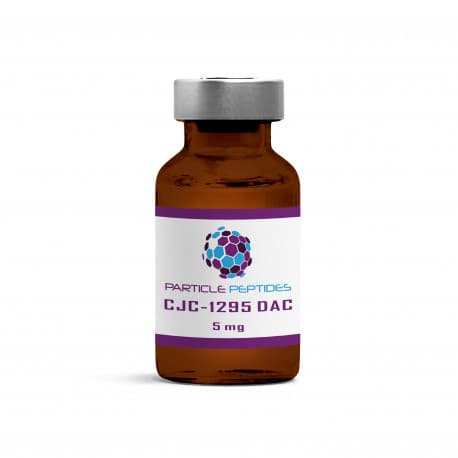
 Particle Peptides
EU-based vendor (Slovakia, since 2015) shipping to EU, UK, and Switzerland. The only European supplier publishing all seven test parameters per batch (purity, identity, content, bioburden, endotoxins, heavy metals class 1 & 2). Manufacturer is cGMP / ISO 9001 / ISO 13485 compliant.
Buy CJC-1295 + DAC 5mg →Affiliate link — we may earn a commission at no extra cost to you.
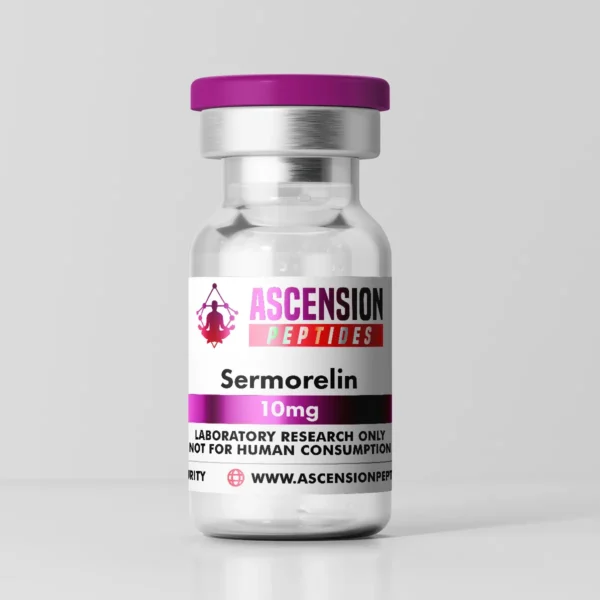
 Ascension Peptides
USA-based research vendor (Castle Rock, Colorado) publishing a per-batch Certificate of Analysis library with public lot IDs, so a vial can be matched to its own COA before and after purchase. Recent HPLC purity 99.79–99.98% across the catalog. Ships from the US and carries the full GLP-1 reference range alongside repair, longevity and cosmetic compounds.
Buy Sermorelin 10mg →Affiliate link — we may earn a commission at no extra cost to you.
Frequently asked questions
- Is CJC-1295 just a longer-acting sermorelin?
- Mechanistically yes — both are GHRH analogues acting on the same receptor. CJC-1295 (no DAC) extends sermorelin's half-life modestly (~30 min vs ~10–15 min). CJC-1295 with DAC extends it dramatically (~6–8 days) but at the cost of natural GH pulsatility.
- What is DAC?
- DAC stands for Drug Affinity Complex — a maleimido-propionic-acid linker that covalently binds CJC-1295 to serum albumin, extending its half-life to roughly 6–8 days. Without DAC, CJC-1295 has a ~30-minute half-life like a typical GHRH peptide.
- Was sermorelin removed because it was unsafe?
- No. Serono voluntarily withdrew Geref (sermorelin) in 2008 for commercial reasons, not safety. Sermorelin remains widely used via compounding pharmacies.
- Can I take CJC-1295 with sermorelin?
- Both target the same GHRH receptor — combining them does not produce additive effects in the way that combining a GHRH and a GHRP does. They are alternatives rather than complements. The standard "stack" for synergistic GH release pairs a GHRH peptide (sermorelin or CJC-1295) with a GHRP peptide (ipamorelin or GHRP-2).
Compute a dose for either peptide
PeptideDose is an educational reference. It is not medical advice and does not replace consultation with a licensed healthcare provider. Doses shown in presets are derived from published protocols and product labels — they are not personal recommendations.