
Sermorelin Calculator
Sermorelin (also known as GRF 1-29) reconstitution and dosage reference — calculate vial concentration, BAC water volume, and exact syringe units below.
Also known as: GRF 1-29, Geref
At the reference preset of a 5mg Sermorelin vial reconstituted with 2 mL of bacteriostatic water, a 0.2mg dose measures 8 units on a U-100 insulin syringe.
Sermorelin is a synthetic 29-amino-acid peptide that reproduces the active N-terminal fragment of endogenous growth-hormone-releasing hormone (GHRH 1-29).
- Concentration
- 2.5 mg/mL
- Draw volume
- 0.08 mL
- Units (U-100)
- 8
- Doses per vial
- ≈ 25
- Reference preset
- 5mg · 2mL · 0.2mg
Reference values from the default preset — adjust the calculator below for your vial.
How to use this calculator›
- 1. Vial — the peptide amount printed on the vial, in milligrams.
- 2. BAC water — the bacteriostatic water added to the vial. More water means a lower concentration and a larger, easier-to-read draw.
- 3. Dose — the single dose being measured, in milligrams.
- 4. Syringe — the barrel being drawn into. The diagram rescales to that syringe, so the same dose sits at a different mark on a 0.3 mL barrel than on a U-100.
Educational reference only — not medical advice or a dosing recommendation.
What is Sermorelin?
Sermorelin is a synthetic 29-amino-acid peptide that reproduces the active N-terminal fragment of endogenous growth-hormone-releasing hormone (GHRH 1-29). By binding the GHRH receptor on pituitary somatotrophs, it stimulates the natural pulsatile release of growth hormone rather than supplying exogenous GH directly. It was originally developed by Serono Laboratories and FDA-approved as Geref in 1997 for diagnosis and treatment of pediatric growth hormone deficiency; the product was withdrawn from the US market in 2008 for commercial reasons, not safety findings. Sermorelin is now compounded for research and clinical use as an alternative to recombinant somatropin, often paired with a ghrelin-receptor agonist such as ipamorelin or GHRP-2 to combine GHRH and ghrelin pathways. The circulating half-life is short — approximately 11 to 12 minutes — which is why research protocols typically use small subcutaneous doses given at bedtime to align with the natural overnight GH pulse.
Where researchers source this
Vendors below have been manually vetted for third-party COA practice and shipping reliability. Verify the current Certificate of Analysis on the vendor's product page before purchase.

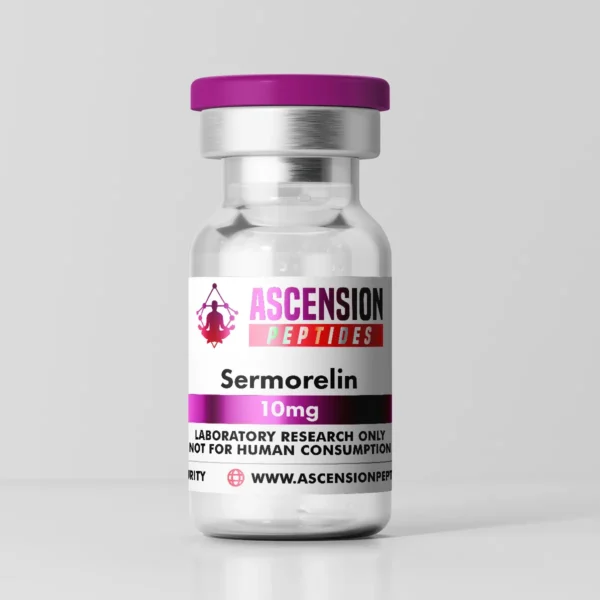
| 2 mg | lyophilized powder |
| 5 mg | lyophilized powder |
| 9 mg | lyophilized powder |
| 15 mg | lyophilized powder |
| 0.1 mg | ≈ 4 U-100 units (at 5mg / 2mL) |
| 0.2 mg | ≈ 8 U-100 units (at 5mg / 2mL) |
| 0.3 mg | ≈ 12 U-100 units (at 5mg / 2mL) |
| 0.5 mg | ≈ 20 U-100 units (at 5mg / 2mL) |
How it's typically prepared
Reconstitute the lyophilized powder with bacteriostatic water injected slowly against the inner wall of the vial; swirl gently to dissolve. Refrigerate the reconstituted solution at 2–8 °C and protect from light; the peptide is generally considered stable for 14 to 28 days under refrigeration. Subcutaneous administration with a U-100 insulin syringe is standard. At the default 5 mg / 2 mL reconstitution (2.5 mg/mL concentration), a 0.2 mg dose draws to 8 units on the syringe.
Sermorelin Dosage
Published research and compounding-pharmacy protocols typically use 100 to 500 µg of sermorelin per dose, given subcutaneously at bedtime. The bedtime timing aligns the exogenous GHRH signal with the body's natural overnight GH pulse, which is the dominant contributor to total 24-hour GH output. A common starting protocol is 200 µg per night for the first week, with optional titration to 300 to 500 µg per night as tolerated. Some protocols cycle five nights on, two nights off, on the rationale of preserving pituitary responsiveness; the empirical evidence for this pattern in adults is limited.
At the standard compounded reconstitution of 5 mg in 2 mL of bacteriostatic water (2.5 mg per millilitre), the syringe arithmetic is straightforward: a 100 µg dose draws to 4 units on a U-100 insulin syringe, a 200 µg dose to 8 units, a 300 µg dose to 12 units, and a 500 µg dose to 20 units. Compounding pharmacies sometimes ship 9 mg or 15 mg vials in the same 2 mL volume — those work out to 4.5 mg/mL and 7.5 mg/mL respectively, so the unit count per microgram is roughly half or one-third of the values above. The calculator on this page accepts any vial size and reconstitution volume.
Sermorelin is frequently stacked with a ghrelin-receptor agonist — most commonly ipamorelin, sometimes GHRP-2 — to combine the GHRH and ghrelin pathways. In stack protocols, equimolar doses of each component are typical, so 200 to 300 µg of each peptide per night is a common pattern. The two peptides are reconstituted separately and either co-drawn into a single syringe at injection time or alternated between injection sites. Because sermorelin's effect depends on residual endogenous GH secretory capacity, response varies considerably with age and baseline pituitary function — clinical decisions belong with a licensed provider.
Sermorelin Dosage Chart
U-100 insulin syringe units for the most common sermorelin doses, calculated at the standard 5 mg / 2 mL reconstitution (2.5 mg/mL concentration). For 9 mg or 15 mg vials reconstituted in the same 2 mL volume, halve or roughly third the unit counts.
| 100 µg (0.1 mg) | 4 units · 0.04 mL |
| 150 µg (0.15 mg) | 6 units · 0.06 mL |
| 200 µg (0.2 mg) | 8 units · 0.08 mL |
| 300 µg (0.3 mg) | 12 units · 0.12 mL |
| 400 µg (0.4 mg) | 16 units · 0.16 mL |
| 500 µg (0.5 mg) | 20 units · 0.20 mL |
Frequently asked questions
- What is the typical sermorelin dose?
- Published research and compounding-pharmacy protocols use 100 to 500 µg per dose, given subcutaneously at bedtime. A common starting pattern is 200 µg per night for the first one to two weeks, with optional titration to 300 to 500 µg per night as tolerated. The choice of dose, frequency, and cycle length is a clinical decision and should be made with a licensed provider familiar with the published literature.
- How many units of a U-100 insulin syringe is 200 mcg of sermorelin?
- At the standard 5 mg / 2 mL reconstitution (2.5 mg/mL concentration), 200 µg of sermorelin draws to 8 units on a U-100 insulin syringe. A 300 µg dose at the same concentration draws to 12 units. The calculator above will recompute the unit count for any vial size and reconstitution volume.
- Sermorelin vs. CJC-1295 — what's the difference?
- Both are GHRH analogues, but the half-lives differ by orders of magnitude. Sermorelin is the unmodified GHRH 1-29 sequence with a circulating half-life of roughly 11 to 12 minutes. CJC-1295 with DAC carries a drug-affinity-complex modification that binds serum albumin, extending the half-life to approximately six to eight days. Sermorelin's short half-life is the reason it is dosed nightly at bedtime, while CJC-1295 with DAC is typically given once or twice weekly. See the dedicated comparison page for a side-by-side reference.
- Why is sermorelin usually given at bedtime?
- Most endogenous growth hormone is secreted in pulses during slow-wave sleep, with the largest pulse occurring shortly after sleep onset. A subcutaneous sermorelin dose given at bedtime is designed to coincide with this natural overnight pulse, amplifying it through pituitary stimulation rather than overriding the circadian pattern. Daytime dosing is also reported in some protocols but the bedtime timing is the most common pattern in the compounded-peptide literature.
- Is sermorelin FDA-approved?
- Sermorelin was FDA-approved as Geref by Serono Laboratories in 1997 for diagnosis and treatment of pediatric growth hormone deficiency. The product was withdrawn from the US market in 2008 for commercial reasons, not on the basis of safety or efficacy concerns. It is currently available in the United States only through compounded preparations supplied by licensed compounding pharmacies. Following the February 2026 HHS reclassification it can be prescribed via a licensed provider working with a compounding pharmacy.
- How long is reconstituted sermorelin stable?
- Reconstituted sermorelin is generally considered stable for 14 to 28 days when stored at 2 to 8 °C and protected from light. The exact in-use period depends on the bacteriostatic water vehicle and any compounding-pharmacy-specific guidance on the vial. Lyophilized powder, before reconstitution, has a much longer shelf life — typically 18 to 24 months refrigerated.
Sermorelin unit conversions
Pre-built lookup tables that convert Sermorelin between common units at the reference 5mg / 2mL concentration.
Sermorelin head-to-heads
Related references
- CJC-1295 — dosage calculator, reconstitution chart, and sources.
- Tesamorelin — dosage calculator, reconstitution chart, and sources.
- GHRP-2 — dosage calculator, reconstitution chart, and sources.
PeptideDose is an educational reference. It is not medical advice and does not replace consultation with a licensed healthcare provider. Doses shown in presets are derived from published protocols and product labels — they are not personal recommendations.